Working with an Offshore Design Studio: What to Expect
Working with an Offshore Design Studio: What to Expect
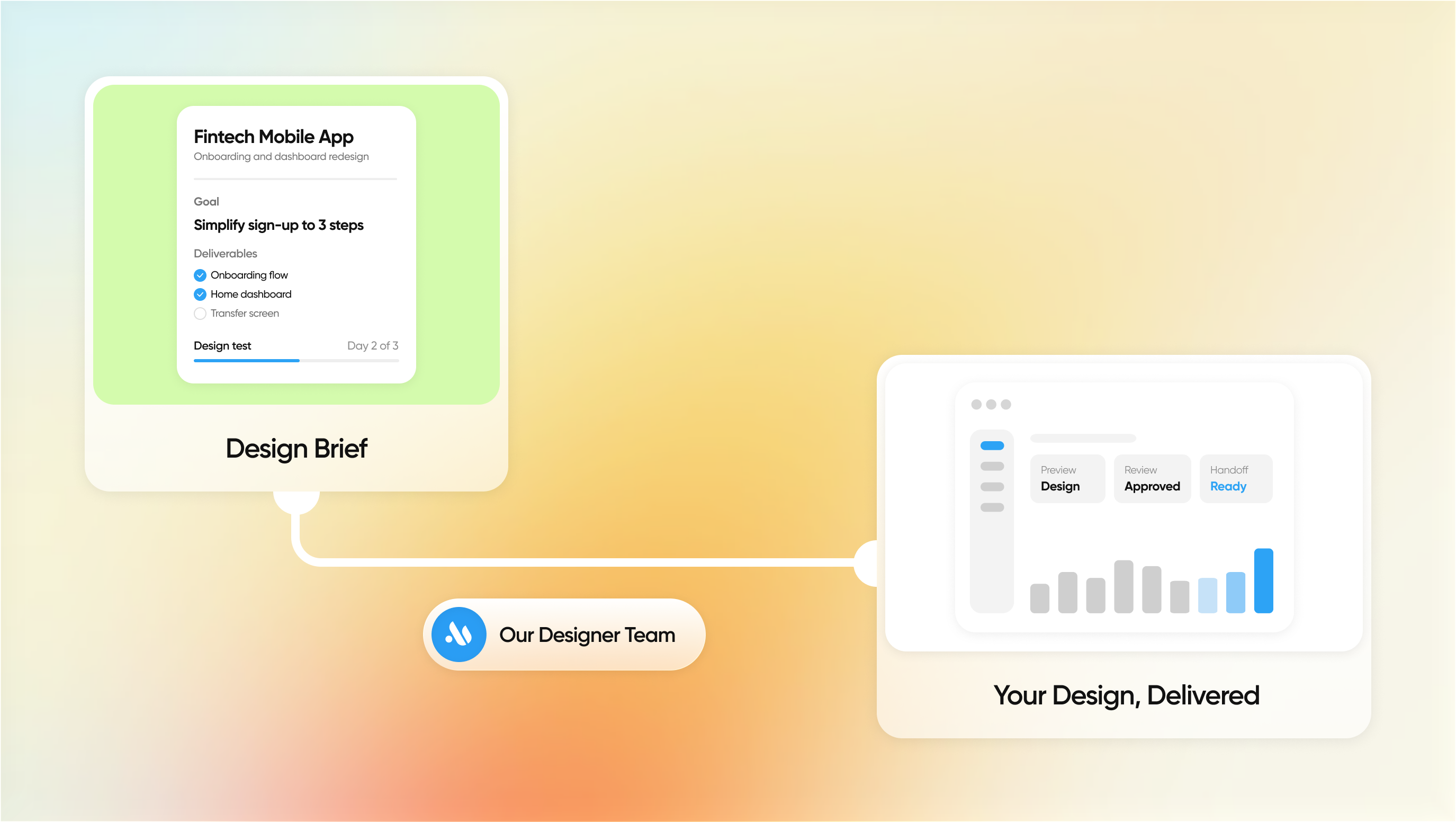
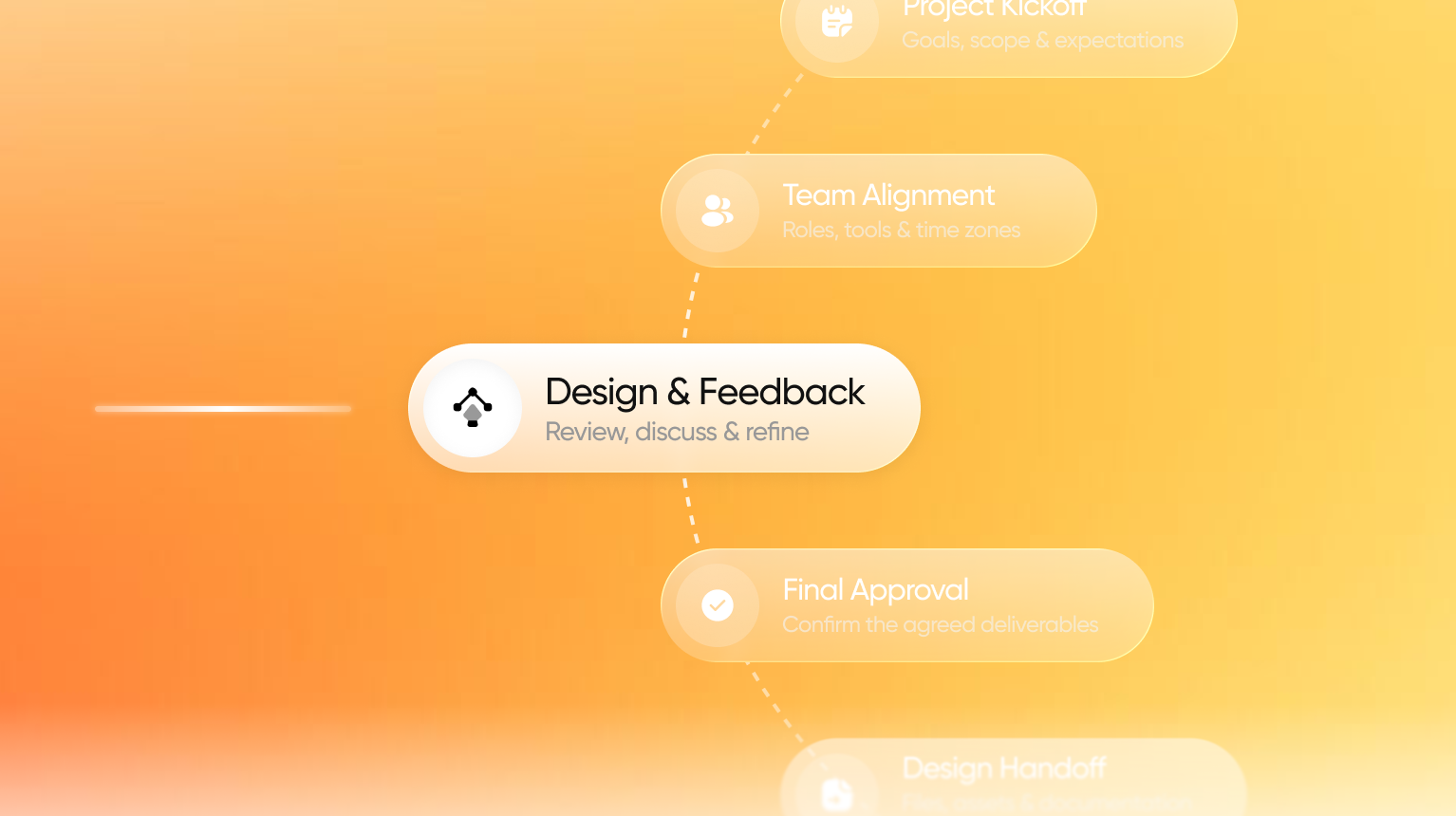
Expect four things from an offshore design studio in Asia: a short paid test before the full project, scheduled meeting windows, written agreements on who owns the files, and international bank transfers that usually take 1 to 6 working days. At Hatypo, based in Surakarta (UTC+7), the design test takes 1 to 3 working days and project meetings run 9am to 5pm Indonesia time.
This article draws on Harvard Business School's reporting on time zone research, Indonesia's Copyright Law No. 28 of 2014 as published by WIPO, Wise's guidance on international transfers, and law-firm summaries of Indonesia's Personal Data Protection Law. The design test and meeting windows describe how Hatypo works today.
I'm Uno, an account executive at Hatypo Studio. I handle scope and budget conversations with new clients, so I hear buyers' concerns about working across borders on first calls. Hatypo is based in Surakarta, Indonesia, serves international clients, and has delivered 250+ projects with various scopes.
Why do buyers hesitate to hire a design studio in Asia?
Buyers usually worry about the same things: whether the studio's quality matches its portfolio, whether communication will hold up across time zones, who owns the work, and how money moves. Those are fair concerns, and each one has a practical answer.
Research on offshore engineering design points the same way. Three US projects that outsourced part of their design work offshore found that clients worried about trust and knowledge sharing, while vendors worried about quality control, communication and schedule control.
Design and engineering are different fields, and the same pattern applies: trust builds when you see real work and talk to the people doing it. A design test gives you both.
How does the Hatypo design test work?
The design test is a paid, short engagement that comes before the full project. It takes 1 to 3 working days and applies to every project type we take: mobile app, web app, website and dashboard.
You give us a brief and we design against it. At the end, you have seen our output and our communication on your own problem, with your own brief as the standard.
What does the test show you?
- Our performance. How we work through your brief inside a 1 to 3 working day window.
- Our communication. How we ask questions, report progress and respond to feedback.
- The result against your brief. Whether the design answers what you asked for.
How should you prepare a test brief?
Choose a brief that matches a real problem in your product, so the result is easy to judge against what you expected. Name one person who gives feedback during the 3 to 5 days, so communication is measured on clear answers.
How do time zones change the way we work together?
Harvard Business School research on more than 12,000 employees at one multinational found that each extra hour of time difference cut real-time communication, such as calls and video chats, by 11 percent on average. Email and chat volume stayed the same.
Plan for it: with fewer live calls, written updates and clear feedback carry more of the work. For east-west teams, the researchers advise getting better at asynchronous communication and setting the expectation that answers won't be instant.
How do time zones change the way we work together?
Harvard Business School research on more than 12,000 employees at one multinational found that each extra hour of time difference cut real-time communication, such as calls and video chats, by 11 percent on average. Email and chat volume stayed the same.
Plan for it: with fewer live calls, written updates and clear feedback carry more of the work. For east-west teams, the researchers advise getting better at asynchronous communication and setting the expectation that answers won't be instant.
When can you meet the Hatypo team?
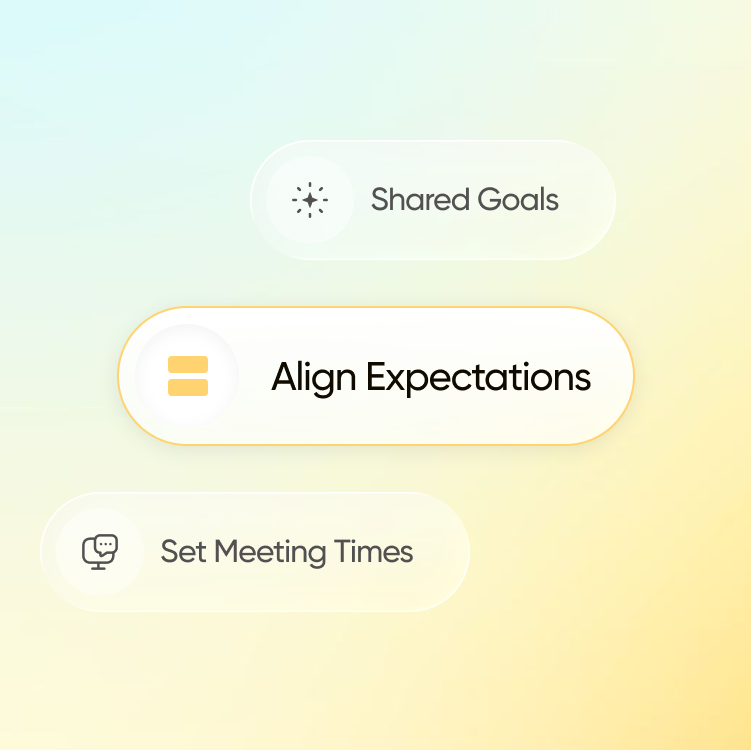
Meetings about a running project happen between 9am and 5pm Indonesia time (WIB, UTC+7). Deal meetings, such as the first call and scope discussions, can happen between 8am and 10pm WIB.
How much of your workday overlaps with ours?
This table counts the hours that fall inside 9am to 5pm local time for the client, based on UTC offsets and the time differences listed by time.is. Ranges cover daylight saving changes, which Indonesia doesn't observe.
For project calls, US clients meet us in their evening. A 9am WIB call on Wednesday is 9pm Tuesday in New York and 6pm Tuesday in Los Angeles, on standard time. Deal meetings reach the New York morning and the Los Angeles evening.
Who owns the design files when an Indonesian studio does the work?
Under Indonesia's Copyright Law, the party that produces a commissioned work is the author and copyright holder unless the parties agree otherwise (Article 36). In practice, the contract is where ownership gets decided.
Copyright can be transferred in whole or in part by several routes, including a written agreement (Article 16). The law's elucidation adds that only economic rights transfer, and that the transfer must be made clearly and in writing.
Moral rights, such as the right to decide whether the author's name appears or to object to distortion of the work, stay with the author while the author is alive (Article 5). Ask the studio how credit and later changes to the work are handled.
Indonesia ratified the Berne Convention through Presidential Decree No. 18 of 1997, according to the law's own elucidation. I'm an account executive, not a lawyer. Have your own counsel read the ownership clause before you sign.
At Hatypo, the intellectual property belongs to the client in full. Whichever studio you choose, ask for that to be stated in the contract before the project starts.
What happens to your data and confidentiality?
Most design work runs on flows, screens and sample content. Where real data is needed, agree in writing what is shared and who can see it.
Ask for a confidentiality agreement before you share product plans or user data. Hatypo signs NDAs. Once your product launches, typically 3 to 6 months later, we publish it on the Hatypo website as a delivered project, so confirm that arrangement in the contract. Fintech and healthtech buyers should raise data handling on the first call.
How do cross-border payments work?
Bank wires sent across borders in a foreign currency often travel over the Swift network. Wise's help pages say these transfers usually take 1 to 6 working days to arrive, and sometimes longer.
Banks between the sender and the receiver can deduct handling fees on the way, so the amount that arrives can be lower than the amount sent. Wise notes that these fees can come from your own bank, an intermediary or the recipient's bank.
Agree three things when you scope the project: the invoice currency, who covers transfer fees, and how many working days the first payment needs to arrive. That keeps a transfer delay from holding up the start of the work.
At Hatypo, payments usually go through Wise, PayPal, or platforms such as Contra and Dribbble. Confirm which route suits you, because each has its own fees and timing.
What should you ask any offshore design studio before you sign?
Put these 5 questions to every studio on your shortlist, including us. The answers should be specific, written down and easy to compare between studios.
- Can we run a paid test first? Ask what the test covers, how long it takes and what it costs. At Hatypo, it takes 3 to 5 working days and covers mobile app, web app, website and dashboard projects. The cost depends on scope and the number of designs, and hourly charging is also possible.
- When can we meet? Get the project meeting hours in writing and convert them to your time zone. Ours are 9am to 5pm WIB, with deal meetings from 8am to 10pm WIB.
- Who owns the files? Ask for the transfer of rights to be written into the contract. Include how credit and later changes to the work are handled. At Hatypo, the client owns the IP in full.
- How is data handled? Ask what the studio needs from you, who sees it and how confidentiality is covered. Share sample content where you can. Hatypo signs NDAs and publishes launched projects on its website 3 to 6 months after launch.
- How do payments work? Agree the invoice currency, who covers transfer fees and how long the first payment takes to arrive. Settle it before the work starts. At Hatypo, payments usually go through Wise, PayPal, Contra or Dribbble.
What four questions settle the decision?
How many hours of design work will you have each week?
Count planned work over the next 12 months. A full week of work suits an in-house hire. A few days a week suits a subscription. An uneven load of large projects suits an agency.
Who briefs and reviews the work?
Every model needs a person on your side who can say what good looks like. Without that person, an agency can supply a lead of its own. A subscription depends on the quality of your briefs.
Which skills does the work need?
List the skills the work needs, such as research, visual design, motion and front-end handoff, and mark how many one hire could cover. The gaps tell you where an agency or a subscription needs to fill in.
What happens when the work stops?
Replacing an in-house designer costs half to two times annual salary, per Gallup's estimate. An agency project ends at delivery. A subscription pauses or cancels on the provider's terms, and Designjoy lets you pause anytime.
Heading 1
Heading 2
Heading 3
Heading 4
Heading 5
Heading 6
Lorem ipsum dolor sit amet, consectetur adipiscing elit, sed do eiusmod tempor incididunt ut labore et dolore magna aliqua. Ut enim ad minim veniam, quis nostrud exercitation ullamco laboris nisi ut aliquip ex ea commodo consequat. Duis aute irure dolor in reprehenderit in voluptate velit esse cillum dolore eu fugiat nulla pariatur.
Block quote
Ordered list
- Item 1
- Item 2
- Item 3
Unordered list
- Item A
- Item B
- Item C
Bold text
Emphasis
Superscript
Subscript
Authors :

How we design with AI without losing craft?
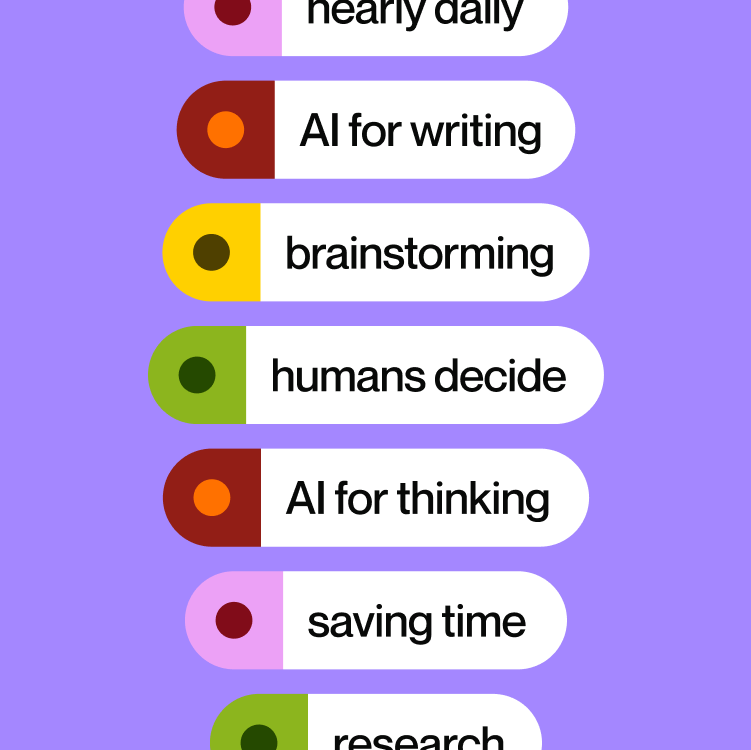
We use AI for thinking and writing, and keep people on visual decisions. In our October 2026 survey of 11 Hatypo, Habito designers and developers, 9 use AI daily or nearly daily, 8 deliberately keep visual design AI-free, and 10 spend the time they save on deeper research. None reported lower quality. Seven of 11 have no settled rule for when AI stays off.
This article draws on our internal survey (16 responses, 11 in scope), Doshi and Hauser's 2024 Science Advances study of AI and creative writing, Microsoft Research's 2025 CHI survey of 319 knowledge workers, and Figma's 2025 AI report of 2,500 designers and developers.
I'm Raull Khaq, COO at Hatypo Studio, and Art Director at Habito, our branding studio. I oversee daily operations across our teams and ran the survey behind this article. Hatypo has delivered 250+ projects since 2021, so I see how AI use plays out in real project work.
Key takeaways
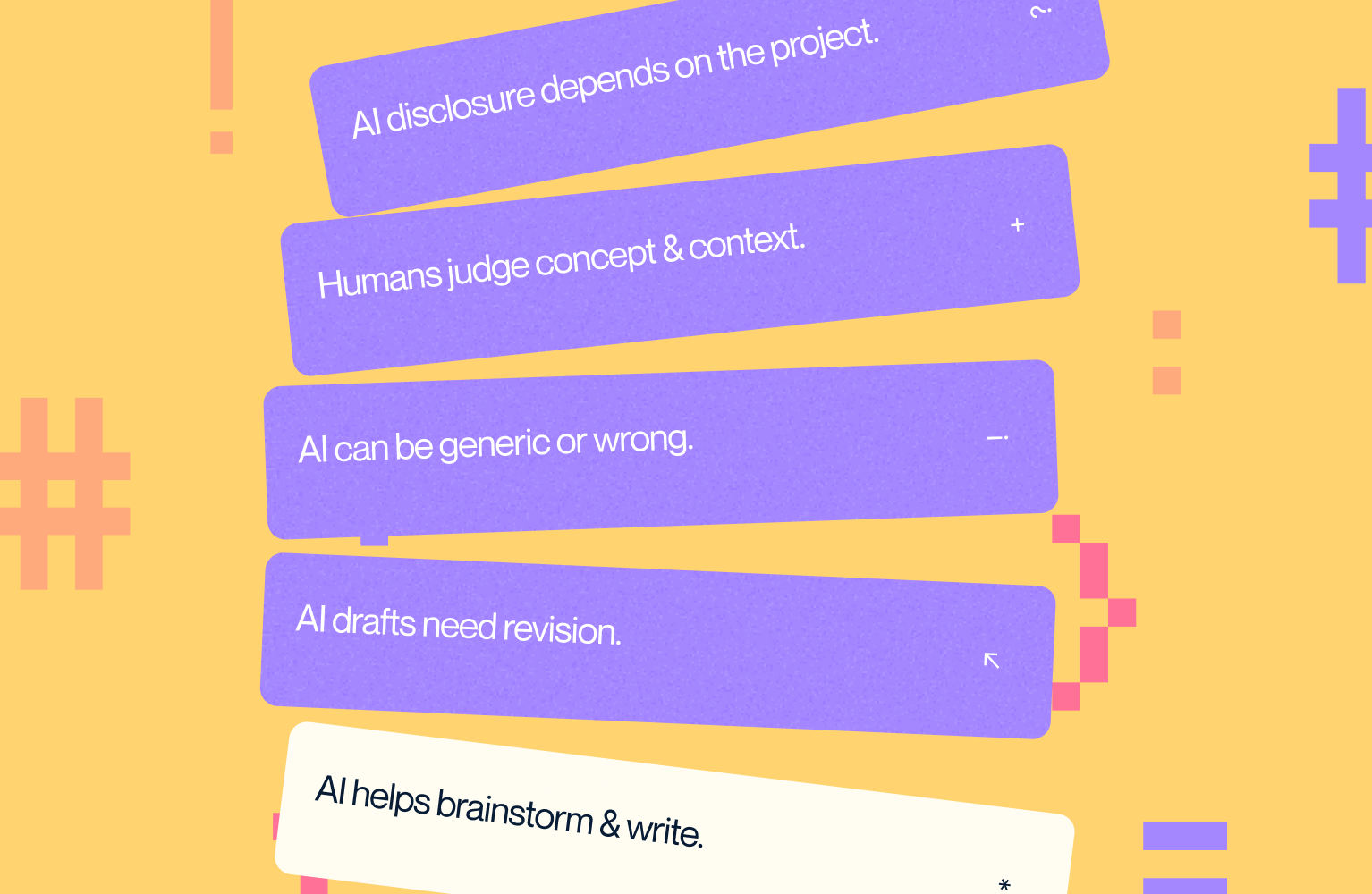
- AI helps most with brainstorming and copywriting, 4 of 11 respondents each.
- Output is a draft: reuse without edits averages 3.1 out of 5, and heavy rework averages 4.0.
- 10 of 11 have seen generic or wrong output, and 5 of them see it often.
- Craft means choosing the concept (9 of 11) and reading the client's context (7 of 11) more often than pixel detail (5 of 11).
- 8 of 11 say whether clients should be told about AI depends on the project.
How did we run the survey, and how far can the data go?
We sent a Google Form to the designers and developers at Hatypo and Habito between 9 and 12 October 2026. Of 16 responses, 5 came from project managers and account executives, so we counted the other 11: 6 UI/UX designers, 3 brand designers, 1 motion designer and 1 front end developer.
Eleven people is a small sample, so we report counts and skip percentages. The answers are self-reported, and the survey came from management, which can push answers toward the positive. Read the numbers as what our team says about its own work.
Where do we design with AI, and where do we stop?
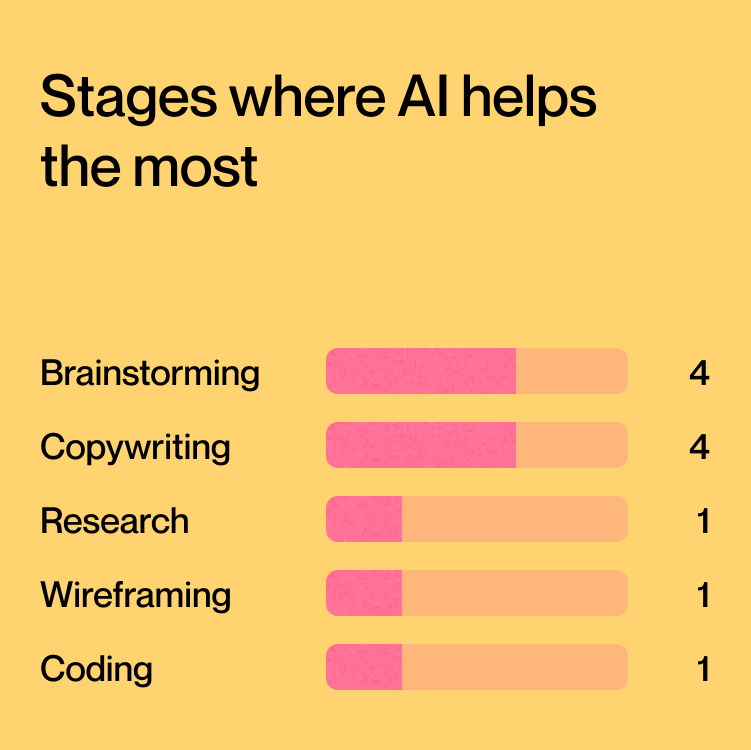
Brainstorming, research and copywriting carry most of the AI work. Four respondents named brainstorming as the stage where AI helps most, four named copywriting, and one each named research, wireframing and coding. ChatGPT (10 of 11), Claude (9), Gemini (8) and Figma AI (7) are the tools in use.
Visual design is where respondents most often stop. Eight of 11 said they deliberately avoid AI there, more than any other stage. Illustration and moodboards followed with 3 each.
The open answers repeat the pattern: AI works on questions and words, and people make the visual calls. One designer put it as a rule: anything that needs empathy for the client or user, and all visual exploration, stays human, while AI handles technical tasks.
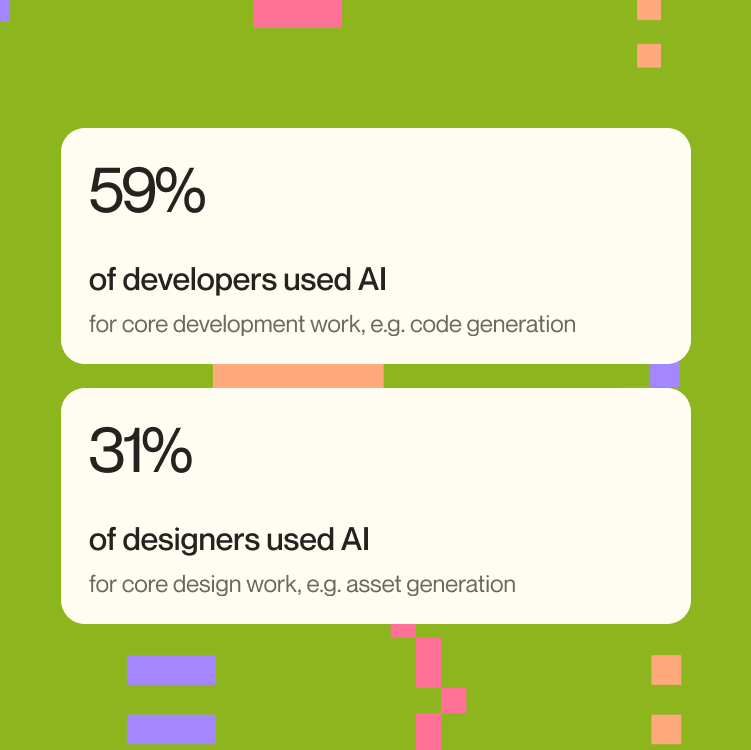
Figma's 2025 report shows a similar split by role. Of its 2,500 respondents, 59% of developers used AI for core development work such as code generation, against 31% of designers for core design work such as asset generation.

How much time does AI save, and where does the time go?
Five of 11 respondents saved 26 to 50% of their working time, four saved 11 to 25%, and two saved more than 50%. Nobody chose the 1 to 10% bracket. In the same Figma report, 78% of respondents agreed that AI significantly improves the efficiency of their work.
The saved time goes mostly into thinking. Ten of 11 spend it on deeper research, five on more iterations and five on rest. Only one respondent uses it to take on more projects.
On our team, saved hours go mostly into understanding the problem.
How often does AI output survive without edits?
Respondents rated how often they use AI output unchanged at 3.1 out of 5 on average (1 is never, 5 is always). They rated how often they rework it heavily at 4.0. Six of 11 gave rework a 4 or 5, and only 3 gave unchanged use a 4 or 5.
In practice AI gives a first version that a person finishes. Final quality still came out higher for 10 of 11 respondents (8 said slightly higher, 2 said much higher), and the eleventh saw no change.
Why does AI output look generic?
Ten of 11 respondents have met generic, wrong or derivative output, and 5 meet it often. Respondents described layouts that start to look alike across projects, with dashboards and wireframes as examples.
A 2024 experiment in Science Advances found the same pattern in writing. Writers who could pick from five AI-generated ideas wrote stories that evaluators rated 8.1% more novel, yet AI-assisted stories were more similar to each other. That suggests the risk sits at portfolio level: each piece looks fine and the set looks alike.
How do we check AI output before it ships?
Ten of 11 respondents check details by hand, 6 compare the output with references, 2 ask a teammate to review it, and 2 test it with a client or user. Peer review is the thinnest of our checks.
A Microsoft Research survey of 319 knowledge workers found that people who trust the AI more apply less critical thinking, while people confident in their own skill apply more. Three of our respondents tied the moments their craft slipped to deadlines, when there was no time to review everything AI produced.
What do our designers and developers mean by craft?
We asked respondents to pick the parts of design they count as craft. Nine of 11 picked concept selection, 7 picked sensitivity to the client's context, 6 picked design decisions, and 5 picked visual detail at the pixel level. The question asked for up to three picks and several people chose more, so read the counts as relative weight.
In their own definitions, people described craft as a good concept, care for the smallest detail, and empathy for the client or user. Craft sits in judgment more than in manual execution, which fits the finding that 8 of 11 let AI work upstream and keep visual execution in human hands.
Has AI lowered our craft, and has it raised it?
Five of 11 respondents said AI never lowered their craft, six said it did once or twice, and nobody said it did often. The reasons were specific: accepting output under deadline, results that felt unoriginal, and a concept the tool could not draw.
Respondents also described gains. They named more time for research, perspectives they had not considered, and visuals that would be hard to make by hand.
Six of 11 say AI helps them learn design skills faster, four see no difference, and one is unsure. Nobody said it slows learning, though the survey asked people to judge their own learning, which is hard to measure from the inside.
What rules keep craft in place?
Four of 11 have a personal rule about when AI is allowed, three are building one, and four have none. The rules differ: no AI for logo design; empathy and visual exploration stay human; execution and the final decision stay with the designer; and AI is acceptable when deadlines are tight or client needs are unreasonable.
The things nobody hands to AI overlap. Three respondents named decision-making and two named logo design. Others named visual exploration, judging a full design from a brief, and what one developer called the soul of the work.
What working rules does the survey support?
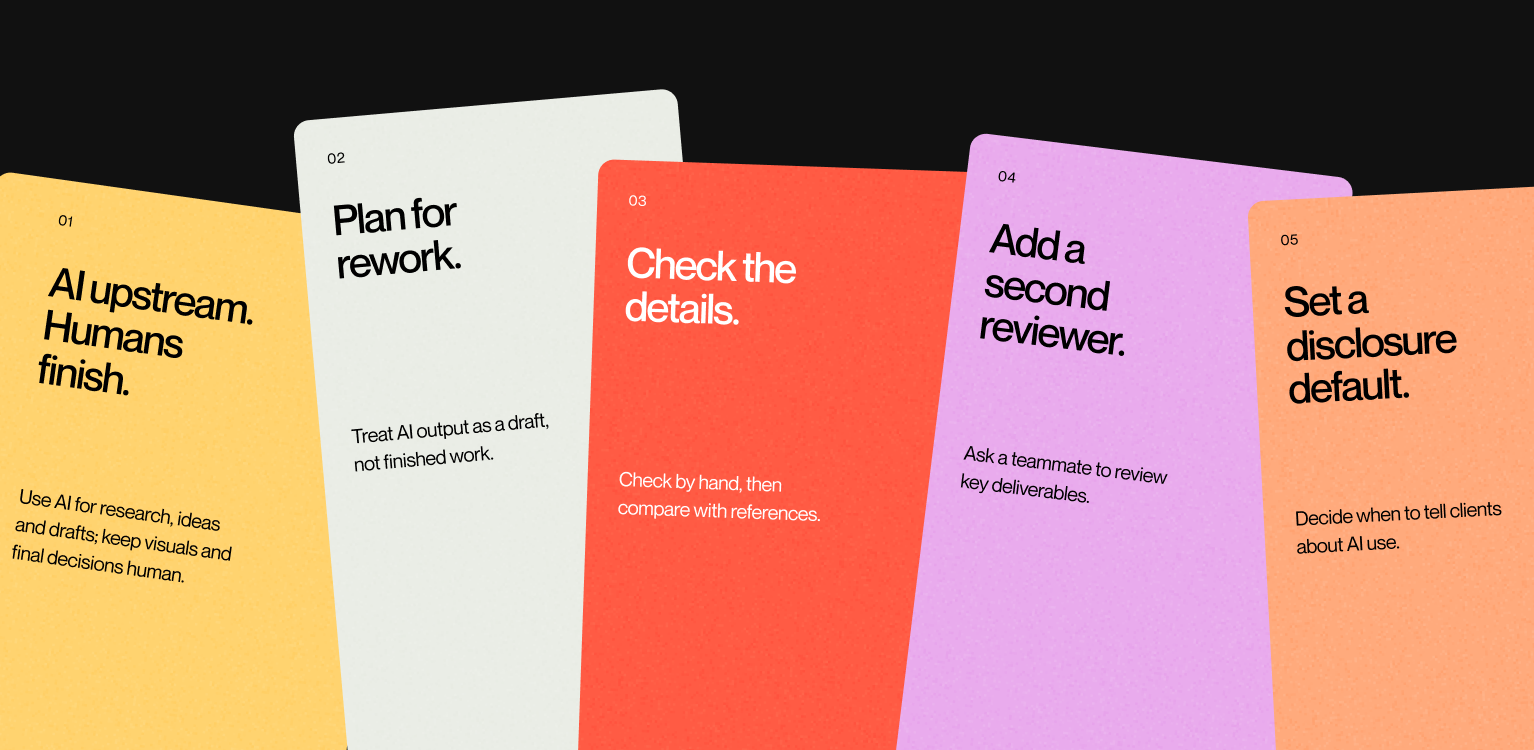
- Use AI upstream and finish by hand. Research, brainstorming and first-draft copy go to AI. A person owns visual execution and the final decision, and 8 of 11 respondents already keep visual design AI-free.
- Plan for rework. Heavy rework averages 4.0 out of 5, so schedule revision time and do not count AI output as done work.
- Keep a minimum check under deadline. Every AI output gets a manual detail check and one comparison with references. Ten of 11 respondents already do the first, and 6 do the second.
- Add a second reviewer on key deliverables. Only 2 of 11 ask a teammate to review AI output, which leaves most checks with the person who made the work.
- Set one default for telling clients. Eight of 11 say disclosure depends on the project, 2 say always and 1 says it is not needed. Without a default, each project gets a different answer.
How can Hatypo help with your product design?
If you want to know where a design studio uses AI on your project and where it does not, we can walk you through our process on a call.
Hatypo has delivered 250+ projects since 2021, and projects start at $3,000, with the price following the scope.
- If you are starting a new product or website, we design it from research through developer-ready files.
- If your current interface underperforms, we review it and propose a redesign scope.
- If your product has outgrown its first version, we rework the key flows and the design system.
Tell us where you are and we will recommend a scope: Book a consultation.

In-House Designer vs Design Agency vs Design Subscription
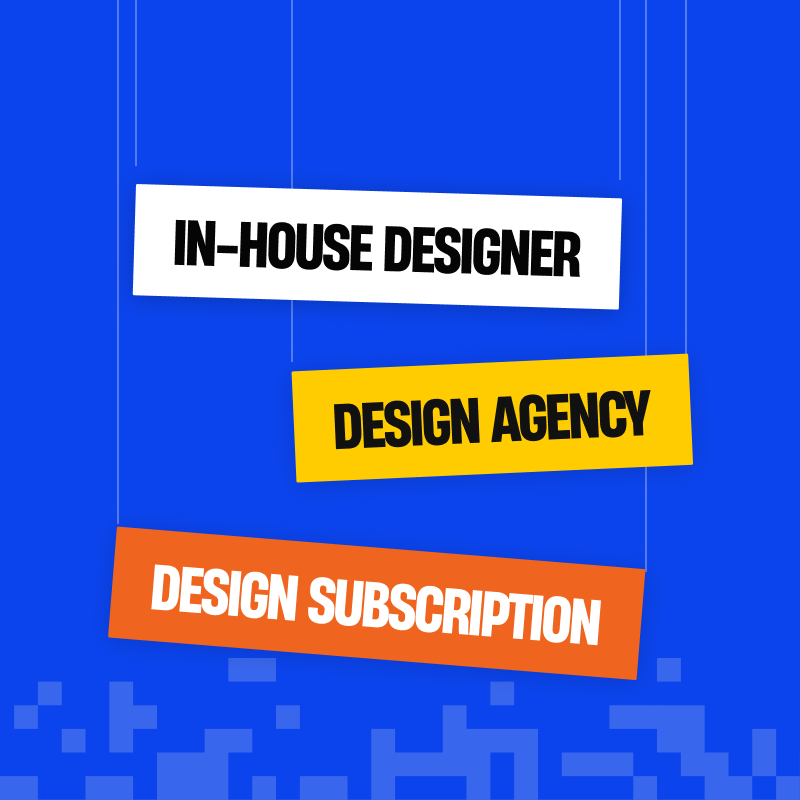
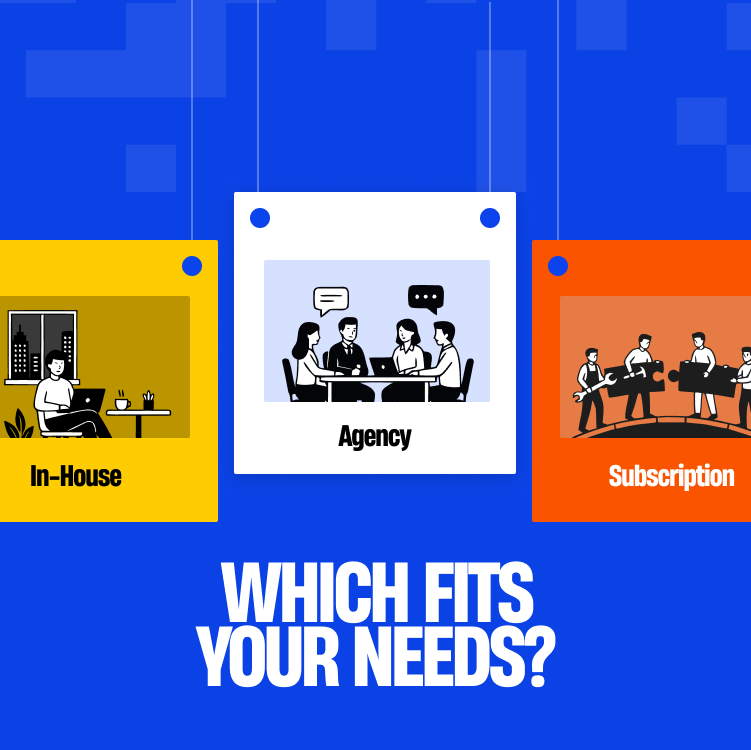
Choose an in-house designer when design work fills a full week, every week. Choose an agency when the work is a defined project with an end date. Choose a subscription when small and medium requests arrive steadily and you can brief them. In the US, an in-house designer costs about $152,000 a year with benefits, the average agency project on Clutch is $56,303, and Designjoy's subscription costs $4,995 a month.
Wage and benefit figures come from the US Bureau of Labor Statistics, hiring time from SHRM's 2026 benchmark, and turnover cost from Gallup. Agency prices come from Clutch's pricing guide, and subscription prices from Designjoy's site and a Superside roundup. Superside is a vendor, so treat its ranges as ballparks.
Key takeaways
- Benefits add about 46 cents for every wage dollar for full-time US private-sector workers, before recruiting, software and management time.
- The median nonexecutive hire takes 39 calendar days to fill, and Gallup puts replacing a leaver at half to two times annual salary.
- Clutch lists $100 to $149 an hour for US design agencies and $25 to $49 for agencies in India and the Philippines.
- In a design subscription, unlimited means an unlimited queue of requests, usually worked one to three at a time.
What does an in-house designer really cost?
The US Bureau of Labor Statistics reports a median annual wage of $104,000 for web and digital interface designers in May 2025, across about 132,700 jobs. That figure is wages only. It excludes health insurance, paid leave, payroll taxes, equipment and software.
What do benefits add?
BLS employer cost data for June 2026 shows full-time private-sector workers cost $54.00 an hour in total: $36.97 in wages and $17.03 in benefits. Benefits are 31.5% of the total. Applying that ratio to a $104,000 salary gives roughly $152,000 a year. That is our estimate, before recruiting, software and management time.
What do hiring and turnover add?
SHRM's 2026 benchmark, covering more than 4,600 organizations, puts median time-to-fill at 39 calendar days for nonexecutive roles. Gallup's 2019 analysis estimates that replacing an employee costs one-half to two times their annual salary. For a $104,000 designer, that is $52,000 to $208,000, and the figure is a general estimate across roles.
What does an in-house designer do better?
An in-house designer builds product context. They join the same standups as engineers and product managers, know why a screen works the way it does, and can review a build the day it ships. That context grows with every release.
Where does a single hire fall short?
One designer brings one set of skills. Research, visual design, motion and front-end handoff rarely sit in the same person at senior level. Work also stops when they're on leave, and a quiet month still costs a full month of salary.
What does a design agency cost, and what do you get?
What does Clutch report for agency pricing?
Clutch's design pricing guide reports an average agency project cost of $56,303, a typical timeline of 11 months and an average monthly cost of $5,102. UX/UI design projects typically cost between $10,000 and $49,999.Hourly rates depend on location. The same guide lists $100 to $149 an hour for US agencies, $50 to $99 for Canada, Poland and Spain, and $25 to $49 for India and the Philippines. Its headline hourly average of $25 to $49 sits beside those figures, so read the location table before you budget.
What do you get for that price?
An agency gives you a team: designers, often a researcher and a project manager, working to a scope and a deadline. You can start a project without a hiring cycle, and you can bring specialist skills such as research, design systems or motion for exactly as long as the work needs them.
Where does the agency model break down?
Clutch notes that fixed-price projects need a thorough scope and leave little room for extra iterations or deliverables without a price change. The agency also rebuilds product context at the start of each project, and a long gap between projects loses some of it.
How does a design subscription work, and what does it cost?
What does "unlimited" mean in a design subscription?
A design subscription charges a flat monthly fee for a queue of requests. Superside's roundup says unlimited services carry limits: in the most common model, requests are worked one at a time, and higher tiers handle two or three at once. Revisions usually continue until you approve the result.
What do subscriptions cost?
Designjoy lists one plan at $4,995 a month: one request at a time, average delivery of 48 hours, and pause or cancel anytime. That is $59,940 a year.
Superside's roundup gives Designjoy's range as $4,995 to $7,995, with graphic-focused plans from Design Pickle and Penji between $499 and $1,695. Growmodo, which adds UI design and web development, runs from $1,795 for one dedicated designer to $8,975 for a team of five.
Where does a subscription fit, and where does it stop?
Subscriptions work for a steady flow of landing pages, feature screens and marketing assets, with one person on your side briefing each request. Designjoy's own FAQ shows the limits: larger requests are split into pieces delivered every 24 to 48 hours, and 3D, animation and video are excluded.
How does Hatypo handle subscriptions?
Hatypo works in two models: project-based and subscription. Project-based work starts at $3,000 and the price follows the scope. Our subscription suits agencies that want to collaborate with us over the long term.
How do an in-house designer, a design agency and a subscription compare?
The table puts the three models on the same factors. Cost figures are US-based and come from the sources above. The in-house figure is our estimate from BLS data.
When should you pick an in-house designer vs design agency vs subscription?
When does an in-house designer make sense?
Hire in-house when you can fill about 40 hours of design work every week for the next 12 months, and someone senior can set direction. As a rule of thumb, below that load you pay for idle time, and above it one designer becomes the bottleneck.
When does an agency make sense?
Hire an agency for a new build, a redesign or a specialist task with a clear end date, especially when no one on your team can lead design. You get a team and a deadline. Expect to spend the first weeks passing on product context.
When does a subscription make sense?
Choose a subscription when requests arrive steadily and each one is small enough to finish in a day or two: landing pages, feature screens, marketing assets. You need someone to write clear briefs. Open-ended discovery research and large product redesigns fit a project better.
Can you combine models?
Yes. Common setups are an in-house lead plus an agency for launches, and an agency-built first version handed to a subscription or a full-time hire once the product has traction. The in-house lead should join agency design reviews so the handoff holds.
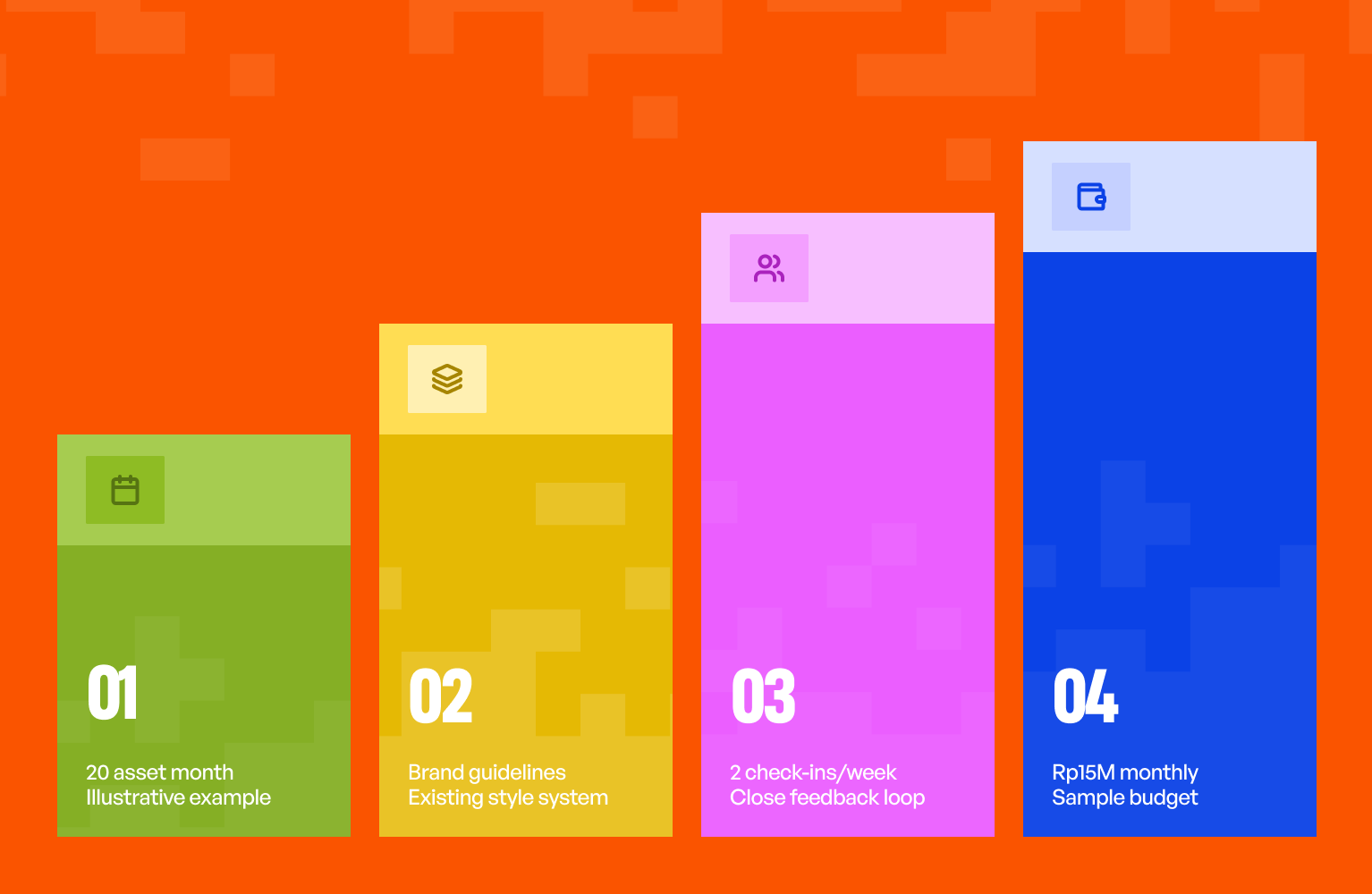
What four questions settle the decision?
How many hours of design work will you have each week?
Count planned work over the next 12 months. A full week of work suits an in-house hire. A few days a week suits a subscription. An uneven load of large projects suits an agency.
Who briefs and reviews the work?
Every model needs a person on your side who can say what good looks like. Without that person, an agency can supply a lead of its own. A subscription depends on the quality of your briefs.
Which skills does the work need?
List the skills the work needs, such as research, visual design, motion and front-end handoff, and mark how many one hire could cover. The gaps tell you where an agency or a subscription needs to fill in.
What happens when the work stops?
Replacing an in-house designer costs half to two times annual salary, per Gallup's estimate. An agency project ends at delivery. A subscription pauses or cancels on the provider's terms, and Designjoy lets you pause anytime.
Corporate Website Redesign: A Guide for Established Companies
A corporate website redesign works when it starts from what buyers, partners, candidates and investors need to do on the site, and ends with a migration that keeps your search traffic intact. For most established companies that means auditing existing content first, mapping every old URL to a new one, and meeting Core Web Vitals and WCAG 2.2 Level AA before launch.
This guide draws on Gartner's B2B buying research, Nielsen Norman Group's content audit method, Google Search Central's site move documentation, web.dev's Core Web Vitals thresholds, the 2025 Web Almanac and the W3C's WCAG 2.2 guidance, plus patterns from Hatypo's corporate projects.
My name is Yunus Ersyah and I am a UI/UX Designer at Hatypo Studio. Hatypo has worked on 100+ corporate client projects since 2021 across property, engineering, manufacturing and other industries. I designed the page structure and interfaces for these sites, and this guide covers the planning and design decisions that repeat across Hatypo’s corporate projects.

When does an established company need a corporate website redesign?
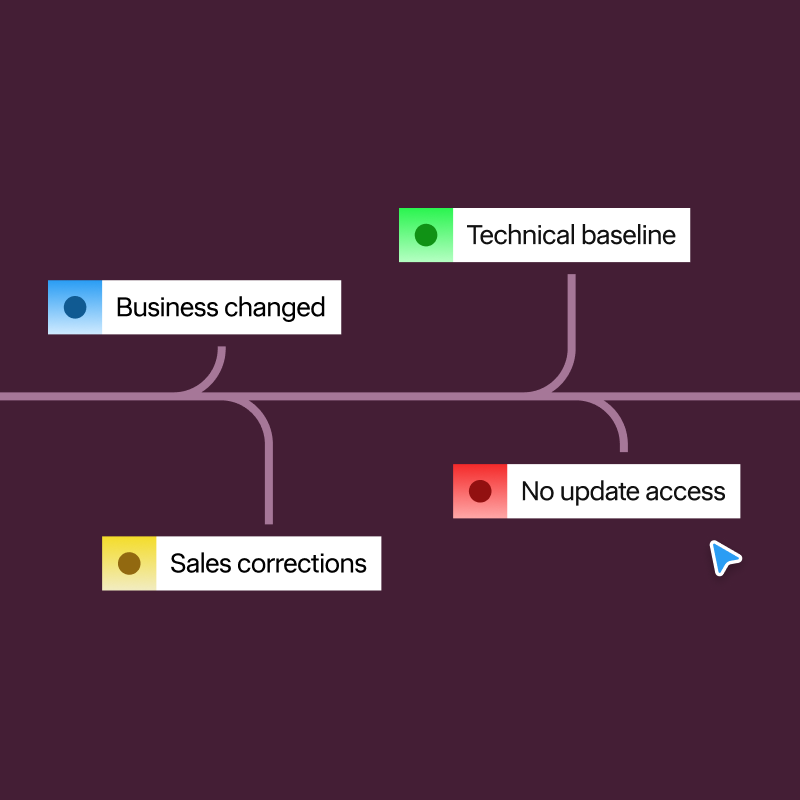
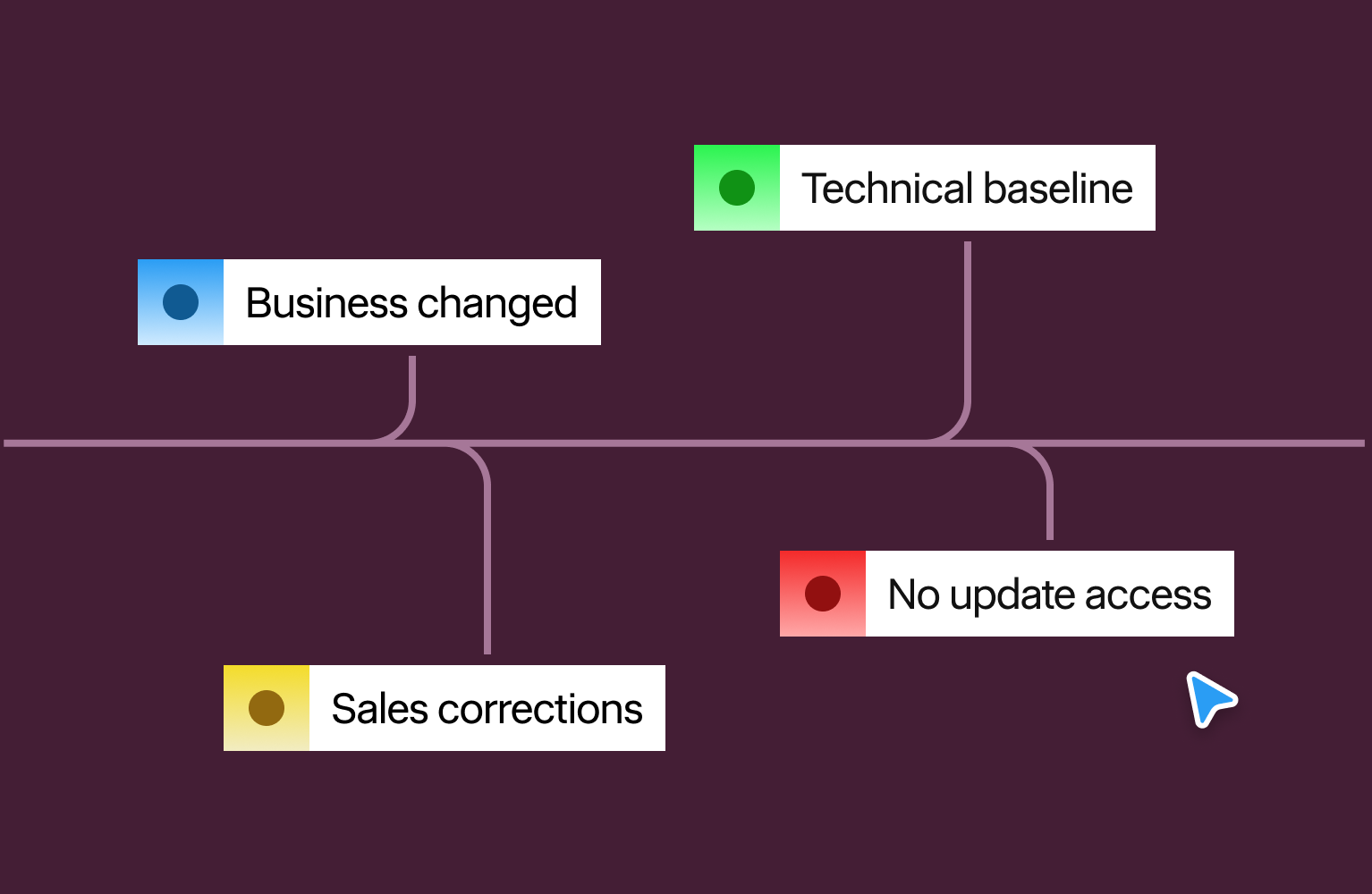
A redesign pays off when the site no longer matches how the company sells, hires or reports. Four triggers come up most often in corporate work:
- The business changed. A merger, a new division or a move into new markets leaves the navigation describing a company that no longer exists.
- Sales conversations start with corrections. When reps spend the first meeting explaining what the site gets wrong, the site is costing credibility before anyone has spoken.
- The site misses the technical baseline. Slow pages, broken mobile layouts and inaccessible forms show up in Search Console and in complaints.
- Nobody can update it. If a text change needs a developer ticket, content goes stale and stays that way.
One trigger justifies an audit. The audit then decides whether the answer is a full rebuild or a focused refresh of the pages that matter.
What should a corporate website achieve?
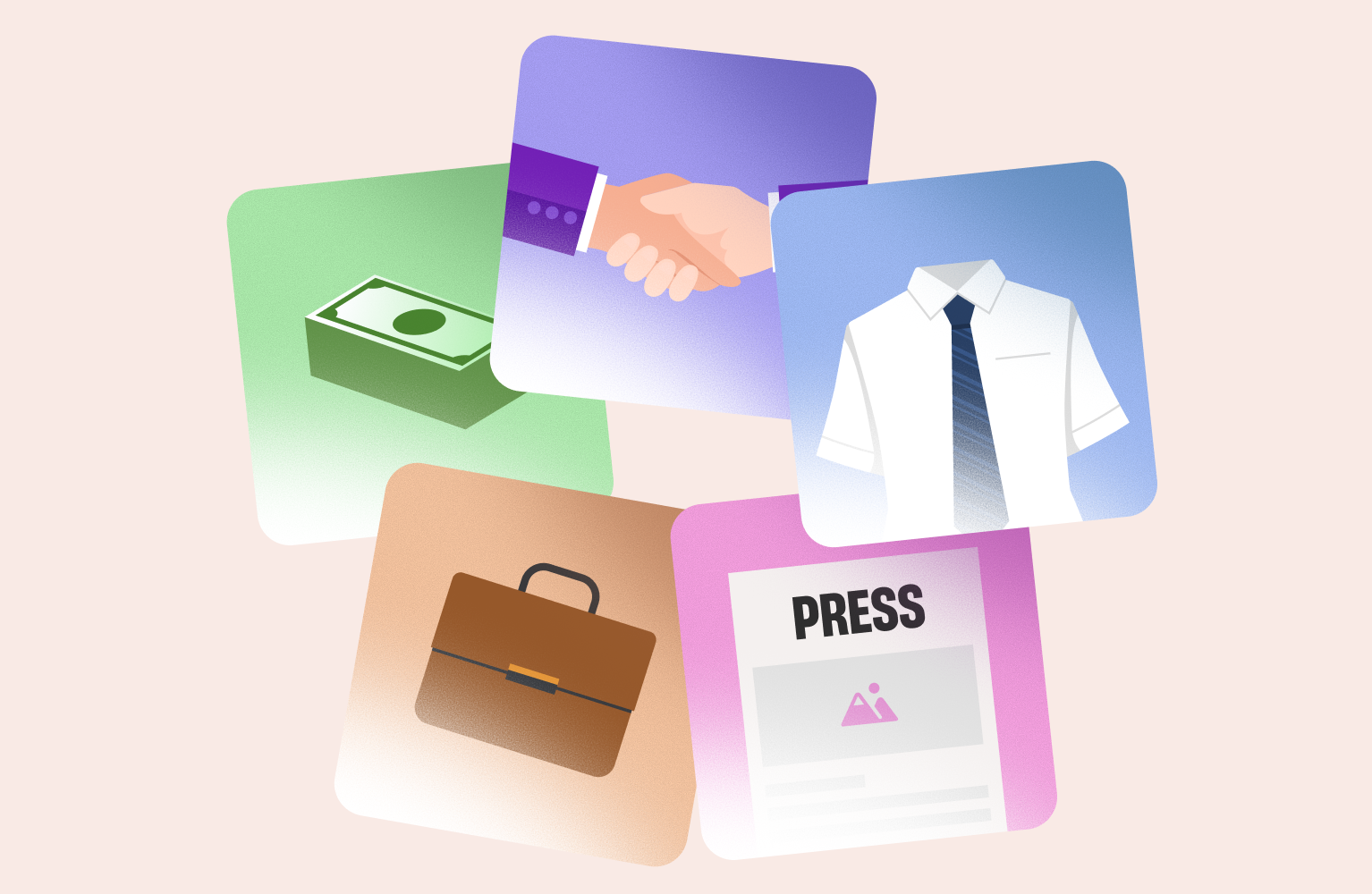
A corporate site serves several audiences at once, and each arrives with a different job to do. Gartner's research describes B2B buyers looping back through each of six buying jobs at least once, with stakeholders using the supplier's website at various points along the way.
Set one primary goal per audience before design starts. Across our corporate projects, five audiences cover most briefs:
- Buyers and procurement teams need capabilities, certifications, project references and a clear way to request a quote.
- Investors and partners need leadership names, company history and figures they can verify.
- Candidates need open roles and a realistic view of working at the company.
- Existing clients need fast routes to support, documents and named contacts.
- Press and regulators need one place for official statements, reports and contact details.
Each goal needs a measure: quote requests, application starts, document downloads. Without one, the redesign gets judged on taste in the review meeting.
Gartner also found that buyers who use a supplier's digital tools together with a sales rep are 1.8 times more likely to complete a high-quality deal than buyers who use them alone. Put a named contact or inquiry route on every page that supports a buying decision.
How do you plan a corporate website redesign?
Planning shapes the outcome. Four steps come first.
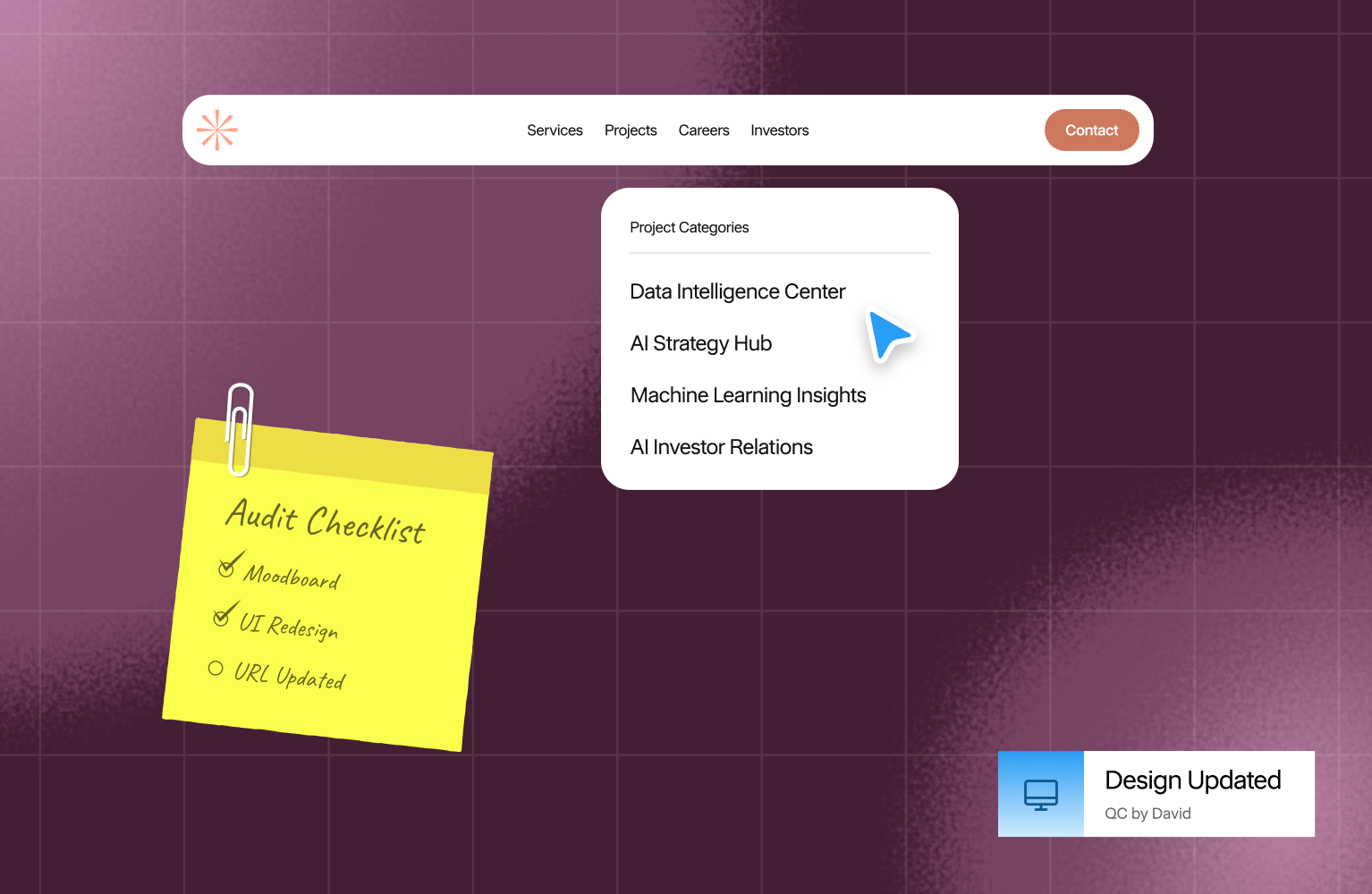
- Audit content before designing. NN/g defines a content inventory as a list of every piece of digital content and an audit as the quality assessment of that list, and recommends doing both. Mark each page keep, update or remove, and give every update an owner.
- Name one decision owner. Corporate sites collect opinions from legal, HR, sales and leadership. One person with the authority to settle disputes keeps the schedule intact.
- Structure navigation around visitor tasks. Group pages under the jobs visitors came to do: find services, see projects, check credentials, apply for a role. Visitors outside the company often don't know its division names.
- Settle migration scope after the audit. Content that gets rewritten or cut changes the timeline and the budget. Decide it before design starts, with the keep, update and remove list in hand.
What do corporate sites need in property, engineering and manufacturing?
The core structure repeats across industries. The proof content changes. This table lists what visitors in three sectors we work with check first, and the page to build around it.
Other sectors follow the same pattern. Find the evidence a buyer needs to shortlist you, then give it its own page.
How do you protect search traffic during migration?
A redesign that changes URLs can lose visibility if old addresses stop resolving. Google's site move guidance lists the controls.
- Map every old URL to a new one. Start with the pages that earn traffic and links, pull the full list from the CMS and server logs, and include images, PDFs and videos.
- Use permanent server-side redirects. Google recommends 301 or 308 redirects and advises against long chains. Sending many old pages to the homepage can be treated as a soft 404.
- Change one thing at a time. Google advises against switching domain, CMS and design in the same release.
- Keep redirects for at least a year. Google says to keep them as long as possible, ideally 1 year or more.
- Remove staging blocks before launch. Take out any noindex rules and robots.txt blocks used during development.
- Monitor after launch. Watch Search Console for crawl errors and indexing changes. Rankings can fluctuate temporarily, and Google says a small to medium site typically needs a few weeks to move most pages.
What performance and accessibility targets should a corporate site meet?
Two published standards give a redesign testable targets. web.dev sets good Core Web Vitals at a Largest Contentful Paint of 2.5 seconds or less, an Interaction to Next Paint of 200 milliseconds or less and a Cumulative Layout Shift of 0.1 or less, measured at the 75th percentile of page loads.
The 2025 Web Almanac found 48% of mobile sites and 56% of desktop sites passed all three, using July 2025 data. Test the homepage and the top landing pages from Search Console. Home pages passed less often than secondary pages in the Almanac (45% against 56% on mobile).
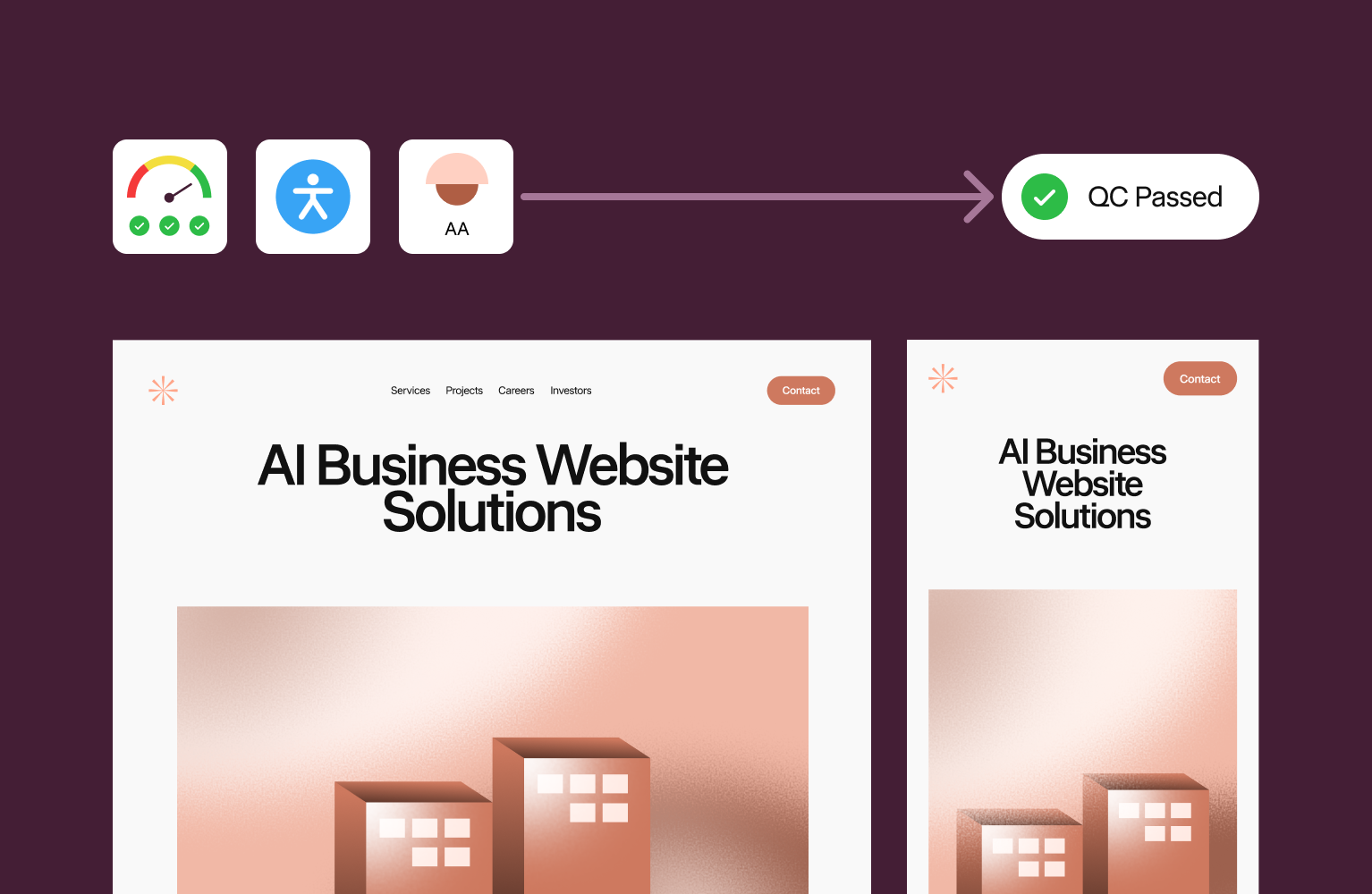
On accessibility, WCAG 2.2 became a W3C Recommendation on 5 October 2023 and adds 9 success criteria to WCAG 2.1. Two Level AA additions affect corporate layouts directly: pointer targets of at least 24 by 24 CSS pixels, and keyboard focus that sticky banners or cookie bars never fully hide.
How do you run a corporate website after launch?
Corporate sites go stale when ownership is unclear. NN/g notes that content audits are ongoing work and tend to fail when they are added on top of someone's existing duties.
- Assign a content owner per section. Services, projects, careers and news each get one named person who approves changes.
- Set CMS roles. Editors change copy, approvers publish and only developers touch templates, so a text edit never waits for a ticket.
- Schedule reviews. Review project pages and certifications every 6 months, and watch the Core Web Vitals report in Search Console for regressions.
- Report against the planning goals. Track quote requests, applications and document downloads monthly, compared with the baseline taken before launch.
Planning a healthtech product that has to be accessible and compliant?
A redesign works best when the audit, the page structure and the migration plan exist before the first screen is drawn.
Hatypo has worked on 100+ corporate projects since 2021 across property, engineering, manufacturing and other industries, and projects start at $3,000 with the price following the scope.
- If you are planning a new corporate site, we plan the page structure and content with you, then design and build it.
- If your current site underperforms, we audit it and fix the pages and flows that cost you inquiries.
- If the company has outgrown its first site, we restructure it around current services and audiences and plan the migration so search traffic holds.
Tell us which stage you're at and we'll scope it together: Book a consultation.